
This guide contains affiliate links. If you buy through one, Coach Luke may earn a commission at no extra cost to you. Read the disclosure.
You twist in your chair, lean over the backrest or ask someone to squeeze you until something pops. For a few minutes your back feels free, and then the urge returns.
That need-to-crack feeling is common, especially in the middle and upper back. Here is what the pop is, why the relief fades and what loosens a stiff spine for longer.
Key Takeaways
- The pop is gas shifting inside a joint, not a bone going back into place
- The urge usually comes from stiffness after long periods in one position
- Gentle movement through the whole spine gives longer relief than forcing a crack
- Back pain with numbness, weakness or bladder changes needs urgent care
What the Crack Is
The small joints of your spine are surrounded by fluid. When a joint is stretched quickly, a gas bubble forms in that fluid and you hear a pop. Nothing has been put back in place, because nothing was out of place.
The stretch does briefly relax the muscles around the joint, which is why it feels good. That effect is short-lived, so the tight feeling comes back.
Why Your Back Keeps Asking for It
- Long sitting. The mid back stays rounded and stops moving through its full range.
- Little rotation. Most daily tasks happen straight in front of you.
- Shallow breathing. The ribs attach to the mid back and move less when you are tense.
- Habit. The more often you crack, the more you notice the urge.
Is Cracking Your Own Back Harmful?
An occasional pop that happens during a normal stretch is generally not a concern. Forcing it many times a day, or having a friend push on your spine, is a different matter. You tend to move the joints that already move well and miss the stiff ones.
Be especially careful with the neck. Forceful self-twisting there is not a habit worth keeping. If your neck is the stiff part, start with why your neck hurts after looking at your phone.
What Loosens a Stiff Spine Instead
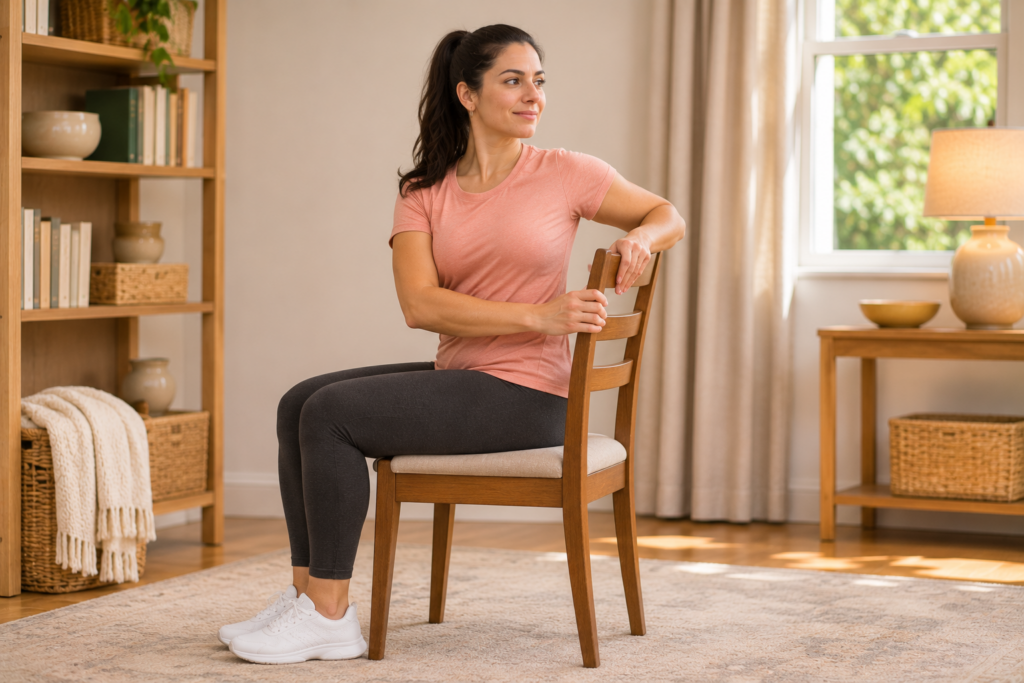
Move it gently and often. On hands and knees, slowly round and arch your back 10 times. Then sit sideways on a chair and rotate toward the backrest, holding for three slow breaths on each side. If mornings are the stiffest time, see why your back is stiff in the morning.
Add extension for the mid back. Lie with a rolled towel or foam roller under your shoulder blades, support your head and ease back over it. The free 5-Day Foam Rolling Challenge from Coach Luke shows how to use a roller safely.
A few minutes a day works better than one long session. If you like the idea of a set daily sequence for the whole spine, one program offers that.
When to See a Doctor
Get urgent help for back pain with numbness around your groin or bottom, bladder or bowel changes or leg weakness, or after a fall. If you have a diagnosed fracture, stenosis or spondylolisthesis, follow your doctor’s plan and skip self-manipulation.
The Bottom Line
The urge to crack your back is a sign that your spine wants movement. Give it gentle bending, rotation and extension every day and the urge usually fades. Lasting change takes steady practice, as shown in how long it takes to get flexible.
This article is for general education and is not medical advice. It does not diagnose or treat any condition. Check with your doctor or a physical therapist before starting a new exercise program, especially if you have an injury, a recent surgery or a health condition.
Stop any movement that causes sharp pain, numbness, tingling or dizziness. See a doctor about pain that is severe, getting worse or has lasted more than a few weeks. This information does not replace their care.