
This guide contains affiliate links. If you buy through one, Coach Luke may earn a commission at no extra cost to you. Read the disclosure.
If your hips feel stiff every time you stand up, you are not alone. Tight hips are one of the most common complaints among people who sit for work.
The good news is that the cause is usually something in your daily routine, which means small changes can help. Here are six everyday reasons your hips feel tight and what to do about each one.
Key Takeaways
- Long hours of sitting keep your hip flexors in a shortened position
- Weak glutes and a stiff lower back often show up alongside tight hips
- Short movement breaks beat one long stretch session
- Sharp, pinching or night pain is a reason to see a doctor
What Tight Hips Usually Mean
The hip flexors are the muscles at the front of your hip that lift your knee. The deepest one, the psoas, attaches to your lower spine. When these muscles spend most of the day in one position, they can start to feel stiff and resist a full stride.
Tight does not always mean short, though. Sometimes a muscle feels tight because it is weak or tired and is working harder than it should. One-sided pain above the buttock is a different pattern, covered in SI joint pain.
6 Everyday Causes of Tight Hips
- Sitting for hours. Your hips stay bent, so the front of the hip rarely gets to open up.
- Weak glutes. When the glutes do less, the hip flexors and lower back pick up the slack.
- The same movement every day. Lots of running, cycling and stair climbing with little variety can leave the hips stiff.
- Sleeping curled up. A tight side-lying curl keeps the hips flexed all night.
- Skipping warm-ups. Going from a chair straight to a workout gives stiff hips no time to adjust.
- Stress and bracing. Many people clench through the hips and belly when they are tense.
What Helps Tight Hips Loosen Up
Start with movement breaks. Stand up every 30 to 45 minutes, walk for a minute and take a few slow steps with long strides. If you sit for most of the day, the free 5-Day Desk Body Reset Challenge from Coach Luke is built for that kind of schedule.
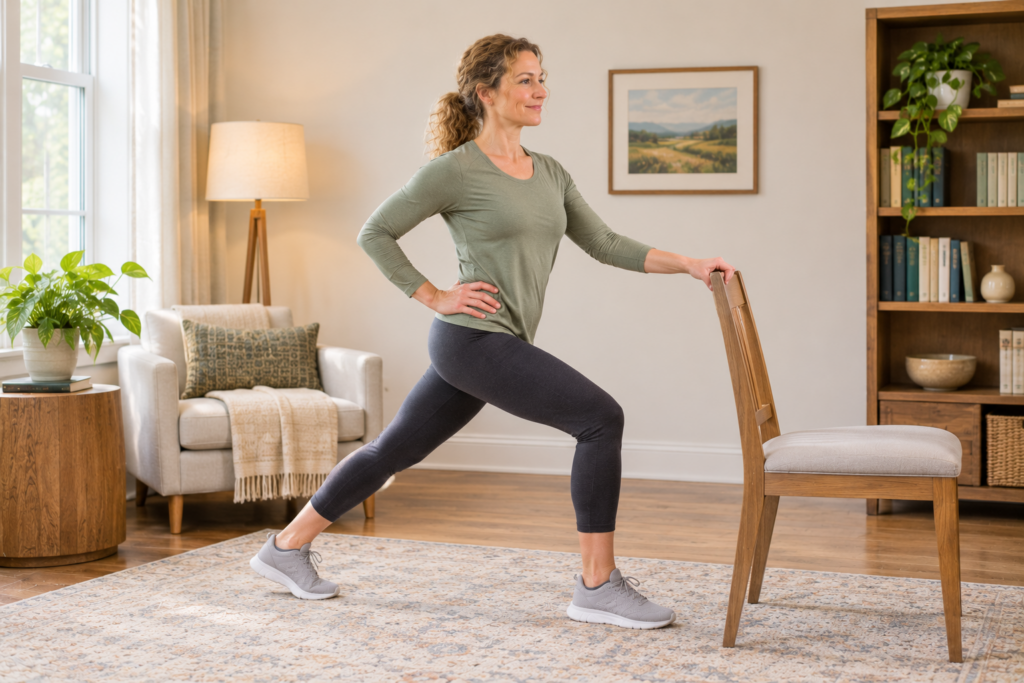
Next, add a gentle hip flexor stretch once a day. A half-kneeling stretch held for 20 to 30 seconds per side is a common starting point. Keep your ribs stacked over your hips and squeeze the glute on the back leg instead of arching your lower back. If you stretch daily and your hips stay tight, see why you are still tight even though you stretch every day.
Then strengthen what is weak. Glute bridges, side-lying leg raises and slow step-ups teach the glutes to share the work, which often does more for tight hips than stretching alone. If your back complains when you get up from a chair, read why your lower back hurts when you stand up from sitting.
If you would rather follow a set routine than piece one together, a structured program can make it easier to stay consistent.
When Tight Hips Need a Doctor
Ordinary stiffness eases as you warm up. See a doctor or a physical therapist if you have sharp or pinching pain in the groin, pain that wakes you at night, numbness or tingling down the leg, a hip that locks or gives way, or pain that began after a fall.
The Bottom Line
Tight hips usually come from how you spend your day, not from one stretch you skipped. Break up long sitting, stretch gently, build your glutes and give it a few weeks of steady practice.
This article is for general education and is not medical advice. It does not diagnose or treat any condition. Check with your doctor or a physical therapist before starting a new exercise program, especially if you have an injury, a recent surgery or a health condition.
Stop any movement that causes sharp pain, numbness, tingling or dizziness. See a doctor about pain that is severe, getting worse or has lasted more than a few weeks. This information does not replace their care.