
This guide contains affiliate links. If you buy through one, Coach Luke may earn a commission at no extra cost to you. Read the disclosure.
Getting down to the floor is easy enough. Getting back up is where many people over 40 start to notice a change: a hand on the sofa, a knee that will not bend far enough, a pause to work out the next move.
It is a common shift and, in most cases, one you can work on. Here is why getting up off the floor gets harder and what helps.
Key Takeaways
- Getting up from the floor needs hip and ankle mobility, leg strength and balance together
- Most people lose the skill because they stop practicing it
- Seated and standing stretches are a good start if the floor feels out of reach
- Sudden weakness, dizziness or joint pain is a reason to see a doctor
Why Getting Up Gets Harder
Rising from the floor is a full-body task. Your hips and ankles have to bend deeply, your legs have to push your whole body weight up, and your balance has to hold while you change position.
After 40, muscles and connective tissue gradually get stiffer, and strength declines if it is not trained. Most adults also stop sitting on the floor, so the movement goes unpracticed for years. Range you do not use fades. The same thing explains why you feel stiff after sitting for a while.
4 Things That Usually Limit You
- Stiff hips. If your hips will not bend or rotate comfortably, you cannot get your feet under you.
- Stiff ankles and knees. A deep bend at both joints is needed to move through a kneeling position.
- Weak legs and glutes. The push from a half-kneel to standing is a single-leg lift.
- Shaky balance. The moment between kneeling and standing has a narrow base of support.
How to Make It Easier
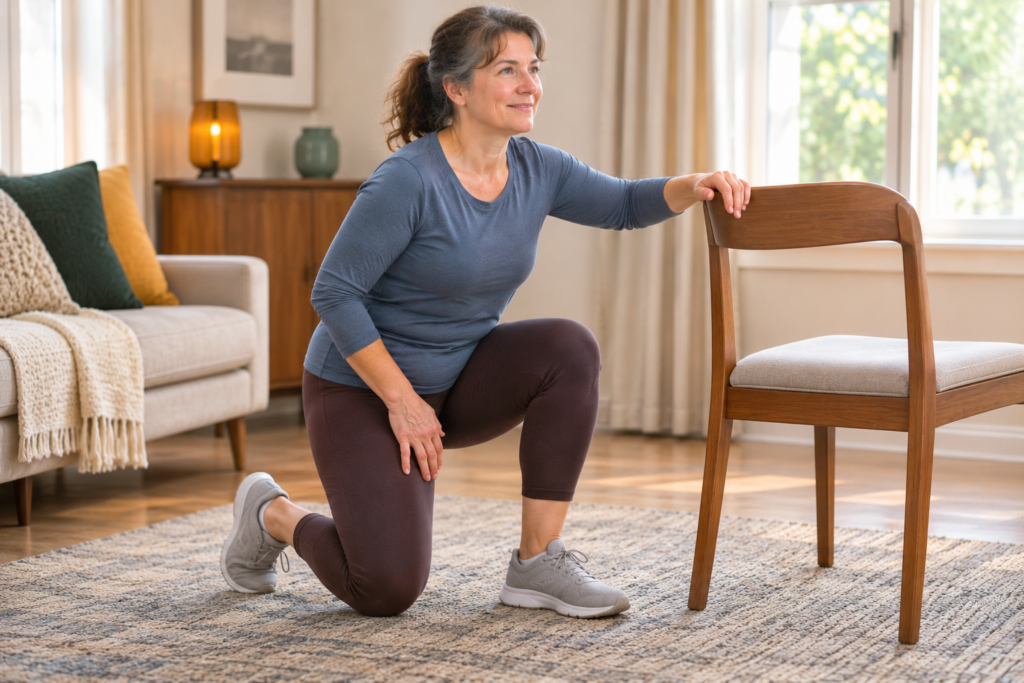
Practice the half-kneel. Stand next to a sturdy chair, step one foot back and lower that knee to a cushion, then stand back up using the chair as little as you can. Start with three to five per side.
Build leg strength with sit-to-stands. Sit on a chair, stand up without using your hands and sit down slowly. Work up to ten. For the balance side of the skill, the free 5-Day Better Balance Challenge from Coach Luke is a gentle start.
Loosen what is stiff. Gentle daily stretches for the hips, hamstrings, calves and ankles make every stage of the movement easier. If the floor is not an option yet, start with seated and standing stretches and work your way down.
When to See a Doctor
Talk to your doctor if getting up has become harder suddenly, if your legs feel weak or numb, if you get dizzy when you change position, or if a joint is hot, swollen or very painful. If you have had a joint replacement, ask your surgeon which positions are safe.
The Bottom Line
Struggling to get off the floor is usually a sign of lost practice, not a permanent change. Stretching gets you into position, and leg strength and balance get you back up. Train all three a little each week and the movement tends to come back. For the bigger picture, read can you get your flexibility back after 40.
This article is for general education and is not medical advice. Check with your doctor before starting a new exercise program, especially if you are pregnant, take medication, or have a health condition or injury.
Stop any exercise that causes sharp pain, chest pain or dizziness, and speak with a qualified health professional about what is right for you. This information does not replace their care.